
When nerves learn new pathways – In conversation about a crucial new aspect of neurosurgery
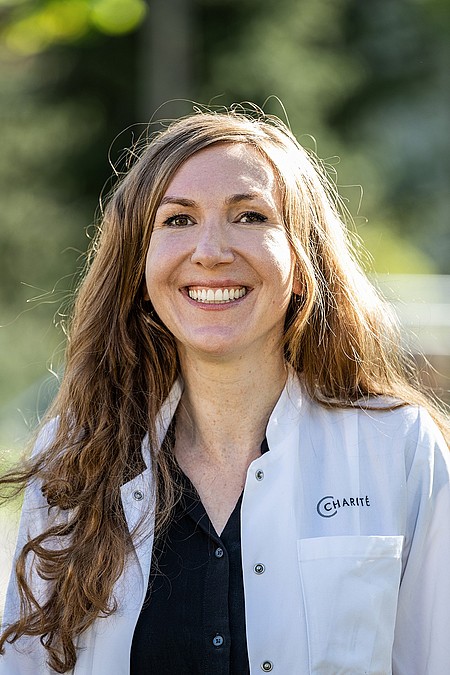
Dr. Anna Zduńczyk is Senior Physician at the Department of Neurosurgery at Charité – Universitätsmedizin Berlin. In 2023, she successfully applied for a Clinical Fellowship from Stiftung Charité. The selection panel and the board of trustees were impressed by her research plan, which involved shadowing world-leading researchers and restorative neurosurgeons at their institutions in Austria and the USA to learn from their experience and discover the latest operative techniques and treatment procedures. She also combined her fellowship with a scientific research study at Charité aimed at improving the predictability of neuroregeneration after surgery. With all these initiatives, Zduńczyk is laying more groundwork for restorative neurosurgery at Charité so that she can use her clinical excellence to give her patients the best possible nerve functionality and quality of life after surgery. We meet for the interview on her ward in the iconic high-rise building at Campus Charité Mitte. Her dedication to her patients is audible in every minute of our conversation.
Dr. Zduńczyk, let’s start with the basics: What exactly is restorative neurosurgery? What sets it apart from traditional neurosurgery?
Traditional neurosurgery is largely concerned with pathologies which need to be removed or treated: brain tumors and hemorrhages, infections of the central nervous system, or spinal issues like slipped discs or spinal stenosis. These are all illnesses which cause a problem somewhere, such as pain or pressure on surrounding tissue. And it’s amazing that modern medicine can operate on all this! For a long time, neurosurgery showed little interest in developing existing reconstructive techniques which could allow lost neurological functions to be re-established. Most surgical techniques are not new, but the ability to offer them to a wide range of patients is. As neurosurgeons, we work closely with our patients. We see how their lives are impacted when peripheral nerve functions are limited after injury or an operation on a brain tumor. As a result, there’s a growing desire within neurosurgery to be able to support people in the post-operative phase too, and that’s where restorative neurosurgery comes in.
It’s still a very young field, having first emerged just under a decade ago. The concept was largely inspired by Justin Brown, one of my mentors at Massachusetts General Hospital in Boston. He’s been instrumental in shaping a concept of neurosurgery which goes beyond the mere removal of pathologies in order to address what happens next. Restorative neurosurgery is resolutely interdisciplinary. We were only able to develop the techniques available today – techniques which can really make a difference – by joining forces with colleagues in hand surgery, plastic surgery, and orthopedics. That’s why I also trained in different areas: I spent a lot of time in plastic surgery, for instance.
On the subject of training: How did you end up in neurosurgery?
After my second semester studying medicine in Leipzig, I was looking for a placement in my home city of Munich. I sought out a specialism that I knew very little about – so that I could learn as much as possible! I actually wanted to be a heart surgeon back then. But then I spent time on a neurosurgery ward and I was immediately captivated. The doctors were incredibly cool and the patients were mostly still young themselves; I learned so much from them. I found the clinical cases really interesting, and I still feel that way today. Neurosurgery was so fascinating from both a clinical and a research perspective, and that’s what pushed me further down this path.
Funding program
Clinical Fellows
Year awarded
2023
Specialism
Neurosurgery
Project
Restorative Neurosurgery
Institution
Charité – Universitätsmedizin Berlin
2022 – present
Senior Physician, Department of Neurosurgery, Charité – Universitätsmedizin Berlin
2018 – 2022
Associate Senior Physician, Department of Neurosurgery, Charité
2017
Additional qualification completed with the European Association of Neurosurgical Societies and the German Society of Neurosurgery (DGNC) in Peripheral Nerve Surgery, Facial Nerve Reconstruction, and Plexus Reconstruction
Who benefits from restorative neurosurgery? Can you give a couple of examples?
Right from the start of my career, patients with facioplegia, i.e. facial nerve paralysis, have been a particular concern of mine. At Charité, we treat many patients with tumors growing on the cranial nerves at the base of the skull. These can impact key functions like swallowing, speaking, facial expressions, and eye movements. The patients are often young and only present with mild symptoms at first: tinnitus perhaps, or slight hearing loss. They might be found to have a benign tumor which can be successfully operated on, but some patients, especially those with larger tumors, may be left with facial paralysis.
The implications are maybe not immediately obvious. But these people can no longer communicate, they have difficulties in speaking, swallowing, and eating, and they also face social stigma due to their appearance. Many are unable to return to work because their reduced blink reflex means that they can no longer sit in front of a screen for long. So many areas of life and basic functions are impacted at once. I came across the technique of facial nerve reconstruction in a lecture by Mariano Socolovsky, a great colleague from Argentina, and I was immediately impressed. When I told my boss Professor Vajkoczy about it, he said: Why don’t you learn to do it? He contacted the Facial Nerve Center at Freiburg University Hospital and that’s where I was able to go and learn the technique.
Today you are highly specialized in peripheral nerve surgery, among other things. What does ‘peripheral’ mean in this context? And are there particular aspects of the human body which peripheral nerve surgery can take advantage of?
‘Peripheral’ simply means everything beyond the skull and the spine. These contain the central nervous system, and anything outside that is peripheral – including the face. Peripheral nerve surgery was originally concerned with finding the best possible way to repair injured nerves after they had been sliced through, for example. But sometimes we encounter more complicated cases where patients come to us months or even years after an injury. By then it’s not so easy to return the nerve to its original function and other techniques are needed. This is how nerve transfer emerged, for example: you take part of a healthy nerve and graft it onto the damaged one. It helps that up to 70 per cent of nerve fibers from a healthy nerve can be removed without impacting its function. Nature gave us a generous surplus!
Our surgical approach is also determined by the proximity of any two nerves on the homunculus, a kind of map which represents the functions of the body within the brain. The closer the nerve functions on the map, the easier it is for one nerve to take on the function of another without the patient having to undergo significant rehabilitation. This is true for the trigeminal nerve (responsible for functions like chewing) and the facial nerve, meaning that we can treat facial paralysis by grafting the trigeminal nerve onto the facial nerve. These techniques work so well that they have also been applied to other conditions too, such as spinal cord injuries: If control of the hands has been lost but the nerves in the upper arm remain intact, then these nerves can be directed to grow towards the hand muscles. Throughout our lives, nerves have a growth rate of around one millimeter per day, even in old age!
This fellowship from Stiftung Charité has enabled you to undertake placements abroad – in Vienna, Austria, and in Boston, Massachusetts and Columbus, Ohio in the USA. What drew you to these three places in particular? Did your experience there live up to your expectations?
I completed all three visits in just one incredible year which truly allowed me to broaden my horizons. Vienna was first, simply because it was closer and the visit was easier to organize. The two stops in the USA came not long after and I did them back-to-back, first Boston, then Columbus.
My time in Vienna was especially valuable thanks to Oskar Aszmann, whom I shadowed there. He is a very interesting neuroscientist who also works as a surgeon. He has a background in plastic and reconstructive surgery and at the same time leads first-rate research into nerve regeneration and nerve composition. We spent a lot of time together during my visit and were able to have in-depth discussions. I came armed with a whole load of questions and his detailed answers greatly enhanced my technical expertise. In truth, I gained so much more from these opportunities to talk directly compared to just watching him in the operating theater. In these moments, I was able to ask those tiny technical questions which you never get to address otherwise. I also got to sit in on his consultations with patients and visit his laboratory. I learned so much in Vienna and was able to apply this knowledge straight away in some of the surgical procedures that I performed once back in Berlin.
Then came your chapter in the USA. What did you gain from your time in Boston and Columbus?
I spent three weeks at the Paralysis Center in Boston which is associated with Massachusetts General Hospital – and by extension with Harvard. I was especially impressed by the interdisciplinary collaboration there: neurosurgeons and hand surgeons worked together closely and sometimes even held joint consultations. This was incredibly useful, as some surgical techniques occur more often in hand surgery while others are associated more with neurosurgery, and sometimes these can be combined into a single intervention, and the patients naturally benefit from this. The surgeons from various specialisms also work alongside occupational therapists, physiotherapists, physician assistants, and PhD researchers. This meant that a very diverse range of roles were represented in each team and processes could be performed as efficiently as possible. For example, far more patients were able to be seen in the outpatient clinics compared to what I sometimes see here. In the closing session at the end of each day, the team could regroup and exchange details about individual patients and their progress: These 15 minutes were a great investment.
After Boston, I went straight to Columbus, Ohio, to shadow Amy Moore. She’s a chief physician and plastic surgeon known for her highly innovative techniques. She was trained by Susan Mackinnon, an influential figure in the field of nerve reconstruction. Amy Moore specializes in the reconstruction of the lower extremities. For a long time, the scientific consensus was very cautious in this area. Since the legs need to bear the body’s entire weight, the demands on the muscles and nerve functions are great, meaning that it is very challenging for surgical intervention to achieve anything. But Amy Moore has made a convincing case with her data that nerve transfer is a good means of restoring functions in this part of the body too. I found this really exciting – and the chance for me to watch this close-up was also important for my patients back in Berlin.
There’s a saying in nerve reconstruction: For those who have a little, a little is a lot. In cases of severe paralysis, even just a small improvement can vastly improve someone’s quality of life! This idea is incredibly motivating for me in my work with patients. They come to me and say that no matter what I do, it can only get better. Often, I can make a difference. But I am also open with my patients: I tell them that we might only be able to get back 30 per cent. But that’s still something! And in the best-case scenario we can restore 80 to 100 per cent of the desired function.
As a Clinical Fellow, you not only took the opportunity to learn surgical techniques and treatment procedures from world-leading experts, but also set up a study involving people with spinal cord and peripheral nerve injuries. Could you briefly explain the aim of your research?
Of course. The traditional scientific consensus on nerve injuries is that we should wait for months to see if the nerve repairs itself, and only operate around month six if no regeneration has taken place. But six months are a long time for a young person. And there are no reliable early markers or parameters which can tell us whether or not a patient will recover. That’s why my group is conducting research into the brain’s motor network to see if there are early differences here between patients who go on to recover well and those for whom this is less likely. If we could identify such markers, then we could potentially operate earlier as we could say in good conscience that it’s unlikely that the nerve will repair itself in certain cases.
The research project also addresses the consequences of surgery: What actually happens in the motor network after reconstruction? When we relocate a nerve, what changes in the brain? Is the impact big or small? How is the network restructured? These are all questions which are absolutely central to us as neuroscientists.
After all the experience which you have gained as a Clinical Fellow, what’s your vision for restorative neurosurgery in Berlin, and at Charité?
A lot started to fall into place just after I returned from the USA. Leila Harhaus-Wähner, a close friend and colleague of mine, became Professor of Hand, Replantation, and Microsurgery at Charité – Universitätsmedizin Berlin in a joint appointment between Charité and Unfallkrankenhaus Berlin. We immediately started holding joint consultations with patients. Our dream is to establish a neuro-reconstructive board review – as already exists for tumors – where representatives from all the relevant disciplines gather around the table. In addition to experts from neurosurgery and hand surgery, we would also have experts from orthopedics, trauma surgery, pediatric surgery, and neurology. Then we could design the optimal pathway for every individual patient.
Charité is a place where an impressive amount of expertise converges – it already attracts international patients looking for new specialist treatment options. I think we could establish the first center for restorative neurosurgery in Europe here!
Dr. Nina Schmidt
April/May 2026