
There’s no such thing as ‘too easy’! Confident communication and public engagement in life sciences
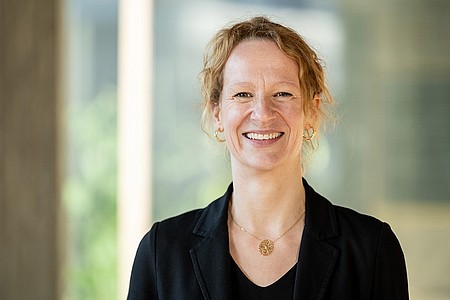
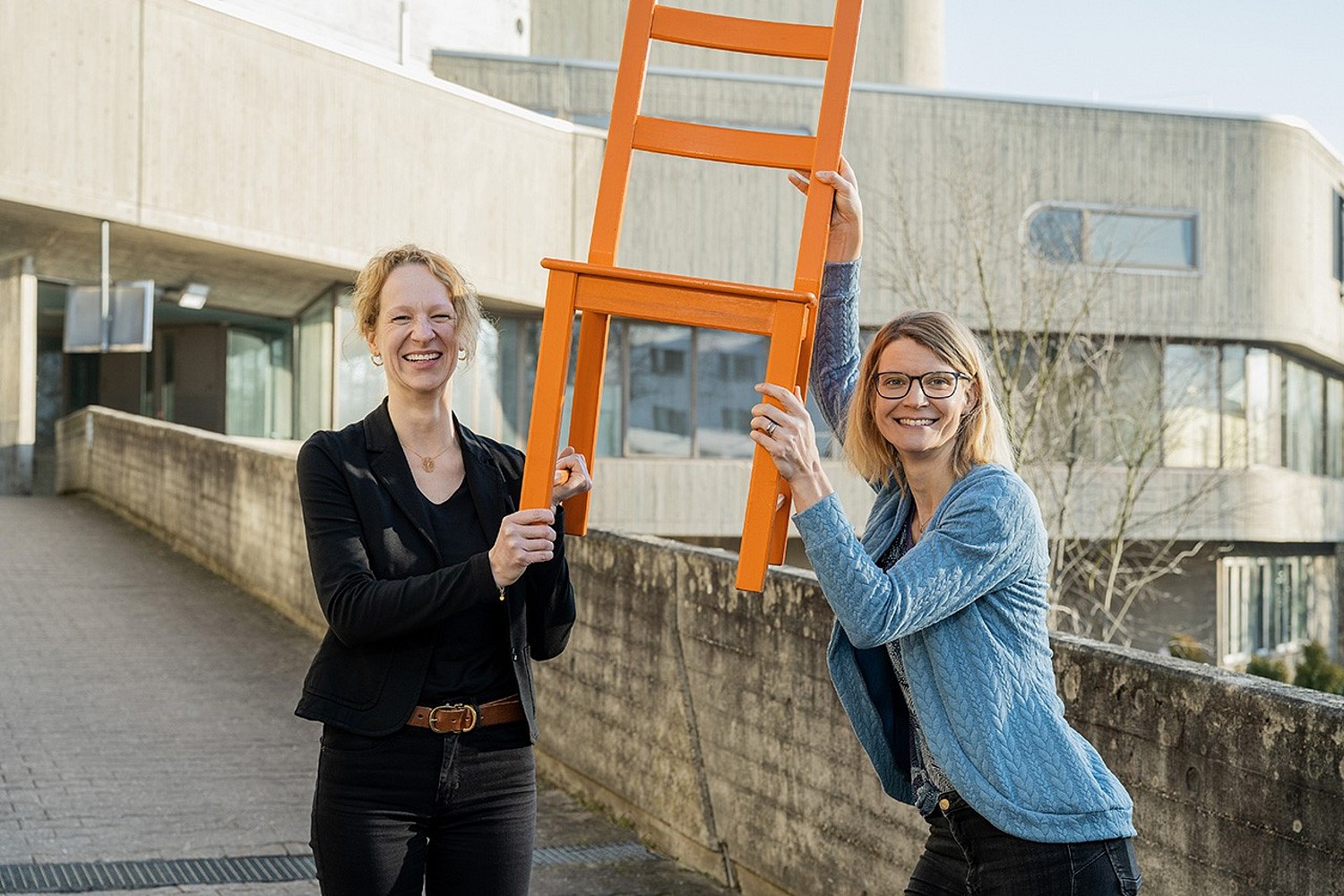
Since 2023, Stiftung Charité has been providing Charité – Universitätsmedizin Berlin with funding to develop and implement the SciComm@Charité training program which represents a central strand of its funding activities in the field of Open Life Science. The program is a response to the rising societal and political demands encountered by life scientists when it comes to communicating their research. With this funding, Charité is the first and only medical school in Germany to offer tailored in-house communications training for both its medics and researchers in the life sciences. The project is led by Dr. Julia Drews from Corporate Communications at Charité. To mark three years of our funding partnership, I met with her and research scientist Dr. Luisa Denkel for a FACES interview at the Institute of Hygiene and Environmental Medicine at Campus Benjamin Franklin. Denkel was part of the first cohort of the training program in 2024.
The third SciComm@Charité cohort began in November 2025. The group will take part in twelve training days until the summer. How was the kick-off and what can the participants expect in the months to come, Dr. Drews?
Drews: The first day of the program is always pretty special. Every year I’m so excited to meet the faces behind the applications and learn about the great range of incredible research that takes place at Charité. Our participants come from every department and are at various stages in their careers, so everyone comes from diverse range of research backgrounds while still belonging to the Charité universe. Everything has always aligned really well so far. A real highlight is the fact that these researchers want to communicate about their work – that is why they chose to apply for a place on our program.
We start the program with an ‘onboarding’ session covering the basic principles of science communication. Why do we need to communicate about science at all? And most importantly, how can we be strategic? Who are our target groups, where do we want our message to land? We also discuss social media dynamics and science journalism. How does science get picked up by the media? We want our participants to gain an understanding of the logic behind different forms of media. Once we have laid out the basic principles, we turn our attention to specific media competencies: putting words on the page, visualizing research, presentation and camera skills. We then round off the program with a final activity to put what they have learned into practice. The experience is truly multi-faceted for everyone involved.
Funding program
SciComm@Charité
Funding period
2023 – present
Specialism
Science Communication
Project
SciComm@Charité: Building communication competencies for scientists at Charité
Institution
Charité – Universitätsmedizin Berlin
2025 – present
Project Lead SciComm@Charité
2018 – present
Science Communication Officer in Corporate Communications at Charité – Universitätsmedizin Berlin
2012 – 2018
Researcher at the Institute for Media and Communication Studies at the Freie Universität Berlin
How were the first two cohorts? Which content or training opportunities were especially well-received – and what did the participants find more difficult?
Drews: It really depends on the individual. Some participants are more social-media savvy, while others are better at writing. But I have noticed that camera training is a highlight for many.
Denkel: The camera and interview training was definitely the highlight for me personally – precisely because it pushed me the furthest out of my comfort zone. It was also very well structured. We were given tips from a journalist and a cameraman and did some exercises before finally starting the main activity. The feedback from both the group and the professionals was really interesting. And seeing yourself on the screen afterwards also takes some getting used to.
But the biggest challenge for me was actually something else – identifying the ‘core message’. These words were the unifying thread throughout the entire course. As a scientist who finds every detail of her work exciting, it’s hard to keep things concise, relevant and comprehensible. You always worry that you might portray your subject inaccurately if you use too few words. I think this was the biggest challenge for most of the others too.
How do you deal with the – sometimes dramatic – changes in the world of science communication from a corporate communications perspective? Social media platforms come and go or get radically restructured, not to mention AI-generated content. What do changes like these mean for SciComm@Charité?
Drews: Technological changes are a fundamental part of our work in communications. We keep a close eye on things to see how they develop or whether something is just a short-lived trend. We always ask ourselves: What aligns well with Charité and our communications? And which platforms are used by our target groups?
The communications sector is currently undergoing radical change due to AI – as is the entire world of work. We also adapted SciComm@Charité in response: since the third cohort we have included a full-day training session on ‘AI in SciComm’ as standard. The issue is also increasingly discussed in our other training courses. We address questions like: Do you still need to learn how to write today? I would say yes because you need to be able to assess the quality of texts produced by Large Language Models. Overall, it is important that we remain agile at SciComm@Charité and keep our program up-to-date.
Dr. Denkel, you work at the Institute of Hygiene and Environmental Medicine at Charité. What prompted you to apply for one of the first places on the program? What did you imagine it would involve?
Denkel: At the Institute of Hygiene and Environmental Medicine, we are responsible for preventing hospital infections and anti-microbial resistance among all patients at Charité. We lead routine procedures and also conduct research studies to identify further effective infection prevention measures. For instance, we test antiseptic bathing on intensive care wards or probiotic surface cleaning. In these cases, communication with medical staff is key.
I was also motivated by my experience working at the Robert-Koch-Institut during the pandemic. During this period, I realized just how difficult it is to communicate from a position of uncertainty. If you issue a correction after the fact, the public will often perceive this as a breach of trust – even though continually correcting yourself over time is a normal part of science. As scientists, we are used to engaging in discussion with our colleagues but this was difficult to convey to the public. I had been reflecting on all this when I saw the call for applications.
Dr. Drews, what is unique about life science communication – how does it differ from science communication in theoretical physics or archaeology, to give some unrelated examples?
Drews: In the life sciences we have the huge advantage that the public is already very interested in medicine and biology. This is backed up by surveys like those published in the annual German ‘Science Barometer’ (Wissenschaftsbarometer). Everyone has at least some background knowledge – especially in relation to their own health or managing their relatives’ illnesses. These topics are relatable and we have a convenient basis of existing knowledge for us to build on. But at the same time, we must take special care to communicate in a sensitive way. We must always remember that the numbers and statistics we work with are directly linked to the hopes and fears of real patients. Ethical questions also feature in our communication – as is especially evident in the case of genetic engineering or animal testing.
At the same time, I want to emphasize that we also have a lot in common with other disciplines. Strategic science communication is fundamentally about being aware of your goals and target groups, expressing yourself clearly, and avoiding unnecessary specialist terminology.
Last year Prof. Christian Drosten, the Director of the Institute of Virology at Charité, gave a prize-winning speech in which he addressed issues such as the politization of research and the loss of public trust in facts. Could this be the biggest overarching problem faced by science communication today?
Drews: Post-truth politics and hostility towards science are definitely a challenge – they endanger research freedom and by extension science communication too. There are also plenty of additional challenges in the field of communications. Audiences are ever more fragmented while at the same time everyone is competing for their limited attention, especially online. Younger generations learn about world events primarily through social media. And soon we will have personal AI assistants to filter content for us according to our individual interests, pre-existing knowledge, and current life stage – maybe even according to our mood that day. So how do we continue to get through to people? We must always be asking and answering this question anew.
How can we tackle these problems?
Denkel: These questions were part of what motivated me to apply to SciComm@Charité: How do I deal with fake news? How do I clear up misconceptions? How do I stay calm and provide a slightly more nuanced picture of the simplistic answers asserted by non-experts? I hoped that this training opportunity would give me the tools to do so. Now it is time for me to practice using them.
I also believe that science communication should be an integral part of the university curriculum in medicine and the natural sciences. It should be introduced early on as part of a life-long learning process. I feel that every researcher must concern themselves with science communication. We are largely financed by public funds so we have a duty to communicate what we do – even when this is outside of our comfort zone. Meanwhile many funders demand that you develop a communication strategy for your research project. We need the right competencies in order to be able to communicate effectively and safely – especially when it comes to social media – so that we can avoid posting anything that might trigger an uncontainable reaction.
Drews: Ultimately it should start in school with media and scientific literacy. A good understanding of statistics is fundamental, for example, when it comes to correctly assessing the risks of illnesses, treatments, and much more.
Have any participants got in touch again after the communications training? And if so, why?
Drews: Yes, this happens regularly. Often people are looking for communications advice on a wide range of aspects – text, video, how to implement their strategy – and I am very happy to help because it shows that they are still thinking about communications once their time with SciComm@Charité is over. Two former participants got in touch with me only recently. Their joint application for Science Year 2026 which is centered on the theme ‘Medicine of the Future’ had been successful. They told me it could not have happened without all the content and tools they gained from SciComm@Charité. Isn’t that great? It shows how participants have succeeded in putting what they have learned into practice.
Designing the program and getting it to where it is today is already a great achievement. After three years of SciComm@Charité, where would you ideally see it in another three years, Dr. Drews?
Drews: I’d of course be delighted to see the program continue as a permanent part of our offer. Stiftung Charité funded us during our start-up phase and the first two cohorts and we are lucky to be able to count on it for another three iterations – that’s fantastic. In terms of the content, I think flexibility is key. We have the overarching structure of SciComm@Charité but every year we re-evaluate and integrate the feedback from each cohort. Ahead of each course we ask: What are the needs of the group? Are there any trends that we should take into account? Demand for places on SciComm@Charité remains high. In each round to date, there have been significantly more applications than places. And there’s huge potential too – there are around 6,000 researchers and doctors working at Charité.
Lastly, who or what has impressed you lately as an example of good science communication?
Drews: Well, I can certainly recommend the communications division at Charité (laughs). But on a serious note, we recently developed a nice SciComm format with our Science Shots. I am personally a big fan of the Quarks Instagram account and the podcast made by the same team called Science Cops. I can also recommend the TV show MAITHINK X on ZDF with Dr. Mai Thi Nguyen-Kim, and the Instagram account Science Optics which has great visuals and covers some medical topics. As a mother, I also appreciate the book series by Torben Kuhlmann which tells stories about famous scientists in a very accessible way for children from around age 5 with a mouse as the main character and lots of illustrations. I like the book about Einstein especially. These books are examples of science communication for a totally different target group.
Denkel: Speaking of science communication for children, we just saw the new Checker Tobi film in the cinema. The TV presenter Tobias Krell does a really great job, I think. He often brings in scientists and tells these great stories about the air, water, the earth or the question of what time really is. The editing is fantastic and as an adult you can learn so much too.
Drews: Absolutely. And that brings me back to something that we have discussed with every cohort of SciComm@Charité to date: there is no such thing as ‘too easy’. Scientists often fear – whether consciously or not – that they will not be viewed as competent if they express themselves in a way that is easy to understand. But they have no reason to worry. No one has ever complained that they were able to understand something easily!
So true! Thank you both very much for your time and our conversation.
Dr. Nina Schmidt
January/February 2026