
Bringing Ideas to Fruition in the Real-World IT Lab: Bridging Research, Clinical Practice, and Administration
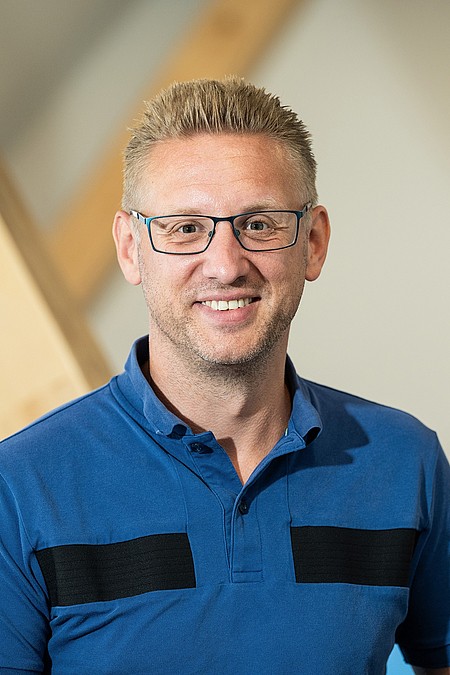
Once a bioinformatics researcher himself, Dr. Björn-Oliver Gohlke is now Head of Science IT at Charité – Universitätsmedizin Berlin, where he runs a Real-World Lab in a team of colleagues from across the university hospital departments. In 2025, the project was granted a Max Rubner Award by Stiftung Charité. The prize served as a catalyst for the project as it provided essential funding for the team to get started. We met at the former Baltic Hotel in central Berlin – where Business Division IT is now based – to discuss the instrumental role that the Lab should play in breaking down bureaucratic barriers and turning innovative ideas into solutions at Charité – Universitätsmedizin Berlin.
The emergency department in the iconic hospital tower at Campus Mitte is usually the first thing Berliners think of when they hear the word ‘Charité’. But there is so much more to it. It is a teaching hospital and medical faculty in one, spread across three campuses all over the city, each of which delivers a combination of teaching, research, and patient care. What role does Business Division IT play in all this?
IT is everywhere, and this is reflected in our new structure. Over the past year and a half, we have split Business Division IT into three subdivisions: Admin IT takes care of administrative processes such as accounting and user management, Medical IT is responsible for systems relating to patient care, ensuring that patients are being properly cared for on the wards and that digital systems are working as they should, and then there is Science IT. This is the subdivision I lead, and it is also where the Real-World Lab funded by the Max Rubner Award from Stiftung Charité is based – here we focus on faculty matters, that is, teaching and learning, as well as science, research and translational medicine. In Science IT, we manage the central systems for around 10,000 students and 6,000 scientists and researchers. We provide the key infrastructure for them: data storage, computing power, everything you need to process and save large datasets, especially in this age of digitalization and AI, not to mention increased cybersecurity concerns.
IT is everywhere, but in the best-case scenario it remains behind the scenes. It is only when something goes wrong that it is suddenly pushed into the spotlight. So from that perspective, whenever IT seems to be invisible, everything is generally working as it should.
How would you describe your role to someone outside your field, say over a coffee or a beer?
There has been quite a bit of change in my case. When we1 won the Max Rubner Award in 2025, I was still working primarily in innovation management. Our Real-World Lab was a natural addition because in IT we see ourselves as responsible for enabling scientists to do their work by granting them access to the resources they need. I then became Head of the Scientific and Translational Services stream before taking on my current role as Head of Science IT as a whole. My role has expanded in connection with this: these days I am responsible for strategic IT coordination and structuring with an emphasis on science and translational medicine – the Real-World Lab will also play an important role in this in the future.
Funding program
Max Rubner Award
Year awarded
2025
Specialism
Information Technology
Project
Establishing a real-world laboratory for testing digital administrative solutions at Charité – Universitätsmedizin Berlin
Institution
Charité – Universitätsmedizin Berlin
2026 – present
Head of Science IT at Charité – Universitätsmedizin Berlin
2017 – 2026
Postdoc at Charité – Universitätsmedizin Berlin
2017
PhD in Cheminformatics at Freie Universität Berlin
And what exactly is your award-winning Real-World Lab? The term crops up increasingly often and in a diverse range of contexts. Some sceptics might say it’s just a fad!
It is certainly having a moment right now in plenty of different fields. In our context, in science and translational medicine, it is about providing a secure technical environment in which we can experiment with digital, often AI-based strategies. The Real-World Lab should be a place where such strategies can be tested under real conditions, in the best-case scenario within a test system running in parallel to the live system so nothing can get broken. The aim is to develop holistic IT solutions and to enable translational science – the application of a research idea in clinical practice, for example. In IT, we support interdisciplinary teams – these days projects rarely belong to just one field and there is almost always crossover. IT is practically always involved and we enable the teams to test out their ideas in a protected environment until they achieve an MVP, a minimum viable product, or a proof of concept, that is, a working prototype.
In practice, this development process moves through three different spaces: the pitch room is where ideas are introduced and assessed – in future we will involve subject experts from the Charité BIH ARC Innovation Center (CBAIC), for example, who can assess whether there is a real need for the idea. It is important to me that this question is not just answered from a financial point of view, but also in terms of added value for patient care. If the idea is promising, we move on to the experimentation room. This is where we really get to the Real-World Lab – here the prototype can be tested quickly under real conditions. If it is found to be fundamentally sound, then we move on to the translation room. Here we clarify what the prototype needs to become a final product and the resources needed to get the product to where it will be used, whether in the clinic, on the ward or on a smartphone. So our Real-World Lab is a place where we can quickly find out if something works before teams start going through long-winded release processes without a sense of whether the project is likely to succeed.
Could you name a specific example, maybe an idea that has already been through the Real-World Lab?
Yes, a good example – and in fact our very first – was a chatbot project for the medical faculty. Dr. Katharina Flemming, one of the team members on the Real-World Lab project, is Head of Business Division Research Services. Her team there told us that it gets a lot of similar questions, the answers to which can be found in the Charité intranet, but the problem is that the intranet can be rather difficult to navigate. This inspired the idea of building a chatbot which could provide quick and competent answers to such repeat questions.
The chatbot project also gave us the opportunity to test out our own Real-World Lab concept and run through it in real conditions rather than on the drawing board. We wanted to see how well our concept would really hold. As a team, we sat down in the pitch room and asked ourselves which stakeholders and areas we would need to involve so that the project could be quickly put into practice. For example, we needed a server, the necessary authorizations, access to the intranet – and a language model to understand and answer user questions. For that we were able to work with the Institute for Artificial Intelligence in Medicine (IKIM) which provides language models for the internal network at Charité. This in-house solution is of course ideal as it ensures that no requests or information leave our organization.
Before moving to the programming stage, we met with all the stakeholders and drew up a data flow diagram together. We checked whether the idea could work under the current conditions at Charité and once we agreed that this was the case, we could make rapid progress. This also illustrates what the Real-World Lab will require of future participants: you can’t just feed it an idea and wait for it to develop by itself. Anyone who comes with an idea also needs to invest time and energy in the next stages and take responsibility for the project as a whole. Only then can the implementation be as good as the initial idea itself.
And what’s the current status of the chatbot prototype?
The chatbot was completed at the end of April and released in the intranet. We did not make an official announcement at first as we just wanted to observe whether the technology worked in general. It was online for around three, four months, and during this time we worked with Dr. Katharina Flemming’s team to assess the quality of the answers. The chatbot is currently offline again while we evaluate the results: how was it received, how many users did it have, how much work did the chatbot produce for the team? Now it is time to step beyond the Real-World Lab to focus on how the prototype can become a sustainable operational model. In the long term, we need to develop an operational blueprint which details who is responsible for keeping the information up-to-date and ensuring that the system remains connected, as well as which committees need to be involved in the operating procedure as standard.
All this sounds like exactly what you want from a real-world lab. You can quickly experiment and learn whether something will work, instead of letting a good idea slowly fade away. Let’s maybe return to the intranet chatbot for a moment. Did you also encounter challenges?
Yes, there were challenges, although these were to some extent foreseeable. As I mentioned before, we made the chatbot go live relatively quickly so that we could test it under real conditions. We considered this action to be without risk as the chatbot would only be operational in the intranet and no data would be made external. Shortly after it went live, the staff council asked why it had not been consulted in advance. This was an entirely fair question seeing as it also had a right to be involved in this decision. In response, we presented our operational concept to the council so that it could grant us approval. This anecdote perhaps illustrates a sticking point in the project, namely that friction can occur when we move to the testing phase so quickly, and we accepted this may happen in this case.
Taking stock, how has the Real-World Lab been going so far, would you say?
Really well! Getting all the stakeholders around the table from the start and turning the idea into practice quickly have been especially beneficial. The collaboration between IT and the IKIM under the leadership of Prof. Alexander Meyer has also been excellent. The IKIM knew exactly what kind of environment we were working in and could give us the relevant support. The same is true for our collaboration with the medical faculty: it was a real pleasure to work on this project since everyone was involved and aware from the start of the coordination needed to make the prototype ready in a short space of time. I’m sure that we will be able to apply this organizational structure to future projects too.
When we step back and look at the big picture, we can see that Charité is currently undergoing several significant processes of transformation – sparked not only by AI but also the new hospital information system and new innovation structures in the form of the CBAIC. What has been your experience of all this change from an IT perspective and what do these extensive processes need to succeed?
It’s certainly challenging, I can’t sugarcoat that. IT is very much in the spotlight in all the areas you mention. But at the same time, I view this as an opportunity to create a more coherent picture of the applications and services we have to offer. Success depends on whether everyone at Charité can get on board. Ultimately, clinicians, researchers, and nurses will all need to work with the new system. Some processes that we have already walked through will inevitably look different in reality. In these times of change, I feel that it is especially important that we stand for open and positive communication within Charité so that we can also discuss what isn’t working, without pointing fingers, and instead in keeping with our motto Zusammen ein Ganzes (‘Together we make a whole’).
What are the positive effects promised by this transformation? Could you spell some of these out for our readers?
Yes, the positive impact includes increased efficiency, reduced costs, and – most importantly – improved patient care. These are the central goals. An important foundation in achieving them is the use of AI, which is by now ubiquitous. At Charité, the IKIM provides us with a good set-up for implementing AI in compliance with data protection and security requirements, as well as the EU AI Act. Nevertheless, we are of course working with limited resources – there’s no billion-dollar datacenter in the basement. This makes it all the more important that we use the really great infrastructure available to us in a meaningful way and communicate openly about what does and does not work.
Let’s end with a more personal question. Has your scientific background helped you in your role today?
Yes, absolutely. I studied bioinformatics, so I have always worked closely with IT systems and databases. I studied for my Bachelor at the Freie Universität Berlin, before moving to Tübingen for my Master, where I could pursue my research interest in medication security. I then returned to Berlin for my doctorate. During my PhD at the Freie Universität and postdoc at Charité, I got to know the structures here from a scientist’s point of view. My career then led me to IT within the old research and teaching division at Charité. Here we worked on projects including the establishment of app development as a service, and also supported large externally funded projects, for example by helping projects to store and make research data available on a long-term basis.
Looking back, my own scientific training has really helped me to understand the technical requirements of our researchers. Science is often fast-paced because of the competition and pressure to publish, and IT has not always been able to match this speed. My background also helps me to develop good concepts and services for personnel and assess what IT should deliver as a centralized service and what researchers should implement for themselves in order to make progress as quickly as possible. This is exactly where the Real-World Lab comes in, as a tool which enables access to IT systems which would not otherwise be available so quickly through the usual protocols.
Dr. Nina Schmidt
August/ September 2026
1 The team has three more members in addition to Dr. Björn-Oliver Gohlke: Dirk Weidlich (Head of Change Management, Business Division IT), Carolin Danker (Executive Assistant to the Dean), and Dr. Katharina Flemming (Head of Business Division Research Services and Contracts) with responsibilities including cooperation with industry.